
August 29, 2026 · 5 min read
The Last of the Piston Fighters: The Hawker Sea Fury and a Freshly Restored Example
The Hawker Sea Fury was the last and fastest of the Royal Navy's piston fighters — fast enough to down a MiG-15 over Korea. A look at the type's remarkable history, and a 1947 FB.Mk 11 with 330 hours since complete restoration now offered for sale.
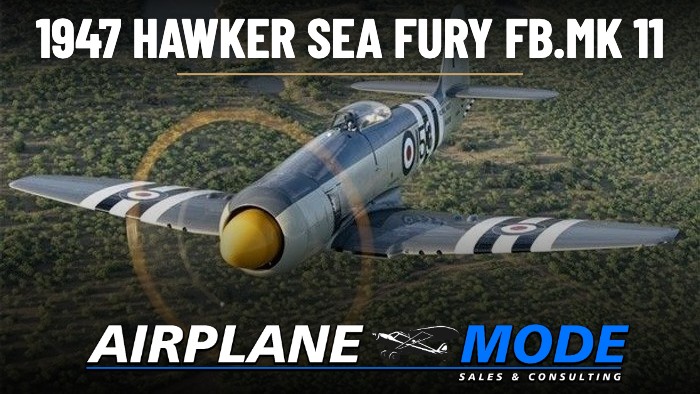
There is a short list of aircraft that represent the absolute peak of piston-engine fighter design, and the Hawker Sea Fury is on it — arguably at the top. It arrived too late for the Second World War and too early to survive the jet age, but in between it proved itself one of the fastest, most capable propeller-driven fighters ever to fly.
Sydney Camm's Masterpiece
The Sea Fury was the final evolution of a design line that began with the Hawker Hurricane and ran through the Typhoon and Tempest — all from the drawing board of Sydney Camm, one of the greatest aircraft designers who ever lived. Where the Tempest was big and brutish, the Fury was refined: a lighter, smaller airframe wrapped around the massive Bristol Centaurus sleeve-valve radial, one of the most powerful piston engines ever produced.
The result was an aircraft that could exceed 460 miles per hour in level flight — numbers that still turn heads at air races today, where highly modified Sea Furies remain front-runners at Reno.
Royal Navy Service and the Korean War
The Royal Navy adopted the navalized Sea Fury FB.Mk 11 as a fighter-bomber, and it was in Korean skies that the type earned its combat reputation. Operating from carriers like HMS Triumph, HMS Theseus, and HMAS Sydney, Sea Furies flew thousands of sorties — ground attack, armed reconnaissance, and air defense.
The Sea Fury's most famous moment came on August 9, 1952, when Lieutenant Peter Carmichael of 802 Squadron, flying from HMS Ocean, was credited with shooting down a MiG-15 jet fighter — one of the very few times a piston-engine fighter bested a front-line jet in combat. It was the ultimate validation of the type's speed, agility, and the skill of the men who flew it.
The End of an Era
The Sea Fury's front-line career was brief — jets moved fast in the 1950s — but the type served air forces around the world, from Australia and Canada to Iraq, Egypt, Burma, and Cuba. When the last military Sea Furies retired, they closed the book on more than a century of piston-powered naval aviation. Nothing that fast and that beautiful would ever be powered by pistons again.
This 1947 Sea Fury: N155
The 1947 Hawker Sea Fury FB.Mk 11 registered N155 is a superb example of the type, showing 1,520 hours total time with only 330 hours since a complete restoration. A fresh restoration on a Sea Fury is no small matter — these are complex, big-engined aircraft, and the quality of the work defines the ownership experience for decades.
Power comes from a Curtiss Wright R-3350-26WB — the 18-cylinder, twin-row radial famous from the Skyraider and Constellation, and a popular, well-supported choice for Sea Furies in civilian hands. It delivers the kind of smooth, relentless thrust that makes the Sea Fury's performance legendary, with parts and expertise availability the original Centaurus can't match.
The Bottom Line
A Sea Fury is not merely a warbird — it is the closing chapter of the entire piston fighter era, and one of the most thrilling aircraft a civilian can own. With 330 hours since a complete restoration and R-3350 power, N155 represents a rare opportunity to acquire one of the finest examples of the type in flying condition.
Airplane Mode Sales & Consulting is proud to represent this aircraft. Full restoration documentation and records are available to qualified buyers — call us and we will walk you through it.