
August 29, 2026 · 5 min read
The Navy's Classroom: The Beechcraft T-34 Mentor and a Standout Low-Time Example
For decades, nearly every U.S. Navy, Marine, and Coast Guard pilot made their first solo in a T-34 Mentor. A look at the aircraft that taught the Navy to fly — and a meticulously maintained 1978 T-34C now on the market.
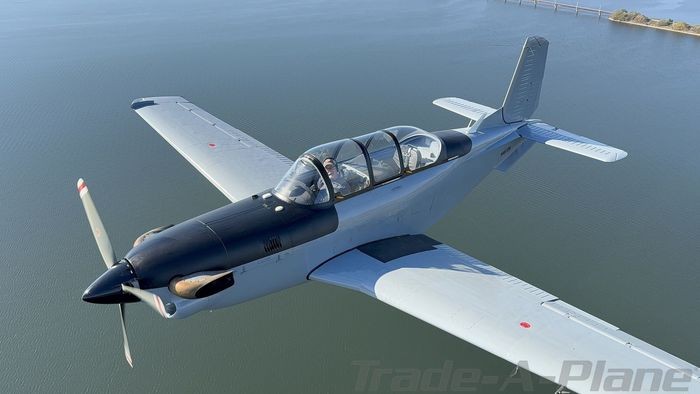
Ask a room full of naval aviators where they learned to fly, and the odds are good most of them will give you the same answer: the T-34 Mentor. For decades, the Beechcraft-built trainer was the first airplane a Navy, Marine Corps, or Coast Guard student pilot ever strapped into — the classroom where carrier pilots, test pilots, and astronauts took their first lessons.
From Bonanza to Military Trainer
The Mentor's lineage is pure Beechcraft. Walter Beech's company took the proven bones of its legendary Bonanza — one of the most successful light aircraft ever built — and reworked it into a dedicated military trainer, first flying in 1948. The result combined the Bonanza's honest, refined handling with the robustness military training demands.
The U.S. Air Force and Navy both adopted the type in the 1950s as the T-34A and T-34B. It was the Navy, though, that would make the Mentor its own, keeping the aircraft in primary training service for generation after generation of student naval aviators.
The T-34C: Turbine Power for the Jet Age
By the 1970s, the Navy needed a trainer that bridged the gap between basic flight and the jets waiting in the advanced pipeline. The answer was the T-34C Turbo Mentor: the same proven airframe, now powered by a Pratt & Whitney PT6A turboprop. The turbine gave students constant-speed propeller management, higher performance, and a genuine taste of the powerplant technology they'd fly for the rest of their careers.
The T-34C served as the Navy's primary trainer for decades, flying from training bases like NAS Whiting Field and NAS Corpus Christi. Aerobatic, instrument, formation, and navigation training all happened in the Mentor. The type earned a reputation as exactly what a trainer should be: demanding enough to teach, forgiving enough to survive the teaching.
A Civilian Second Career
When the Navy finally retired the T-34C, a wave of well-maintained, fully aerobatic turboprop trainers entered civilian hands — and the warbird and sport flying community took notice. A civilian T-34C offers turbine reliability, military build quality, and genuine aerobatic capability in a package with one of the richest training pedigrees in aviation.
This 1978 T-34C: N4872M
The 1978 Beechcraft T-34C Mentor registered N4872M is an outstanding example of the breed, showing 13,835 hours total time — typical for a working trainer, and a testament to how hard these airframes were built to work. More important than the number is the maintenance behind it.
This aircraft has received a recent airframe IRAN (inspect and repair as necessary), a landing gear overhaul, new wing bolts, and new flap cables — the exact items a knowledgeable T-34 buyer asks about first. It was repainted in 2021 and presents accordingly. Critically, it is not subject to the spar airworthiness directive that affects some examples of the type, removing the single biggest maintenance question hanging over the T-34 market.
The Bottom Line
The T-34C occupies a rare sweet spot: a genuine military warbird with turbine power, aerobatic capability, and practical cross-country legs, supported by a knowledgeable owner community and a proven airframe. N4872M adds the maintenance pedigree that separates a good Mentor from a great one.
Airplane Mode Sales & Consulting is pleased to offer this aircraft. Full logbooks and maintenance records are available to qualified buyers — call us to discuss it.